

Why is my Georgia Power bill so high?
We understand that energy costs are a significant part of every customer’s budget, and we're here to explain what's behind your bill and hopefully help you lower it.
Rate Freeze in effect through 2028 – Although we can’t control how much energy you need, we have committed to not raising the price we charge for it until at least 2028.

What's behind the price of energy?
We ensure our customers have access to clean, safe, reliable, and affordable electricity while meeting Georgia’s growing energy needs.
Keep reading ▾
- A growing demand for energy due to the unprecedented growth in our state's population and industry over the past few year means more generating resources need to be pulled in.
- Increased fuel costs result in higher fuel prices for generating electricity in our plants. Under Georgia law, we cannot make a profit on fuel costs.
Under Georgia law, we cannot earn a profit on fuel costs.
- Compliance with environmental regulations at both the state and federal levels.

Could another rate plan save you money?
We offer seven rate plans that vary in price depending on the season, your energy usage, and the time of day or night when you use electricity.
Keep reading ▾
Some plans, like our Time of Use rates, offer a lower rate during off-peak hours when electricity production is cheaper but charge a premium for energy used during on-peak demand hours when generation costs are higher (typically from 2 p.m. to 7 p.m. June through September).
If you can’t avoid using a lot of energy during peak demand hours, it might be helpful to consult our Rate Advisor to determine if a different rate plan is better.
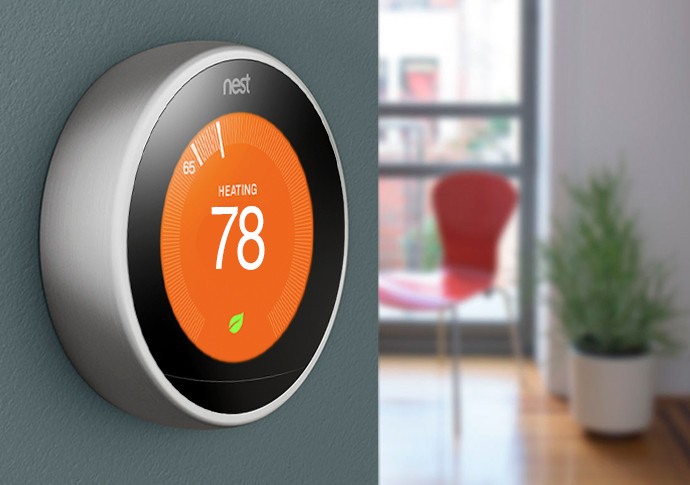
Are your appliances wasting energy?
Depending on the season, as much as 50% of your household's energy usage may come from your heating or cooling system*.
Keep reading ▾
- Running ceiling fans instead of adjusting your A/C is a great way to save while staying comfortable in your home. Every degree on your thermostat can mean as much as 3-5% on your monthly bill.
- Keep air vents clear of obstructions and change standard air filters once a month or pleated filters every three months. Restricted airflow forces your AC to work harder, increases wear on your unit, and consumes more energy.
- Unplug devices when not in use to avoid standby energy drains.
Tools and helpful resources


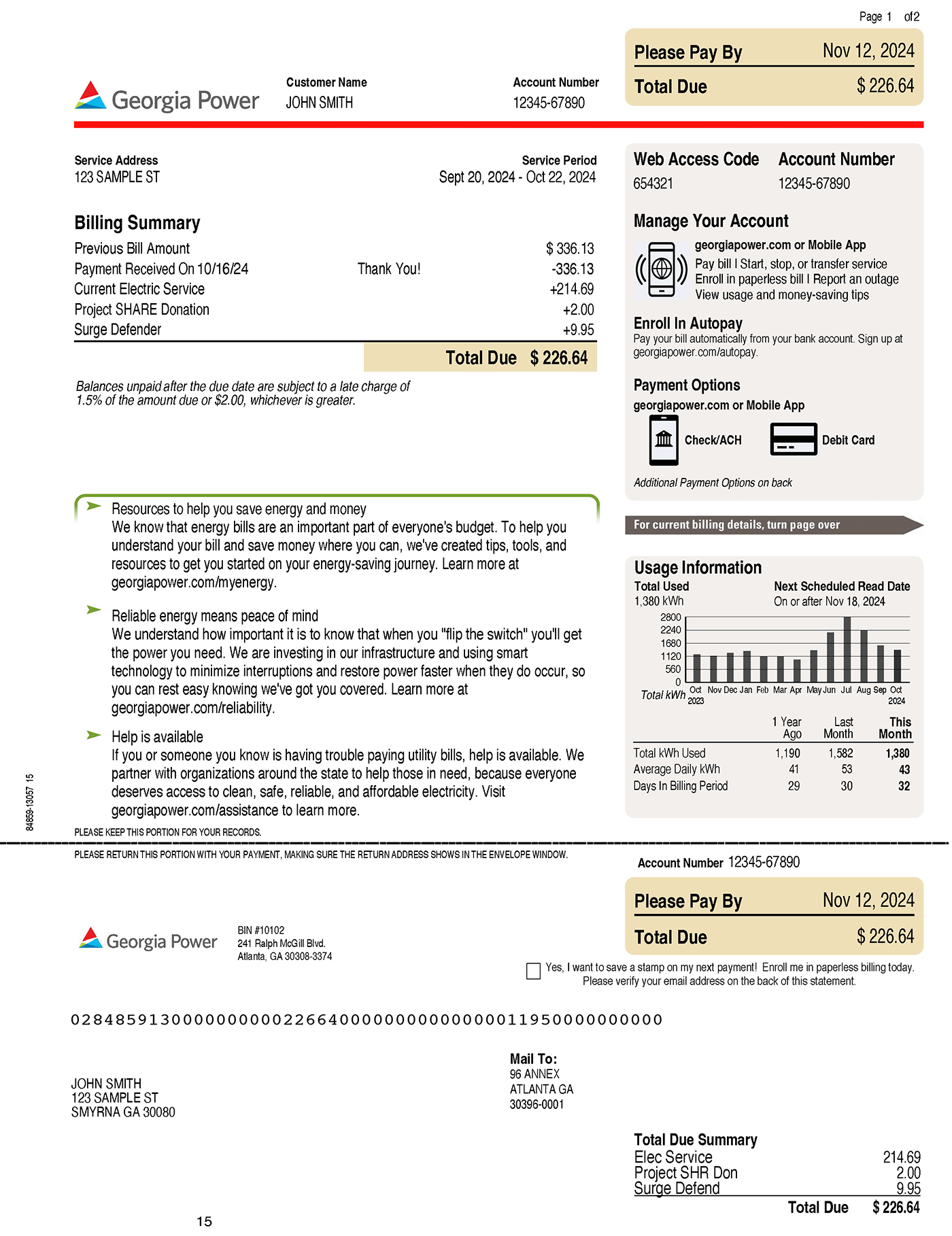
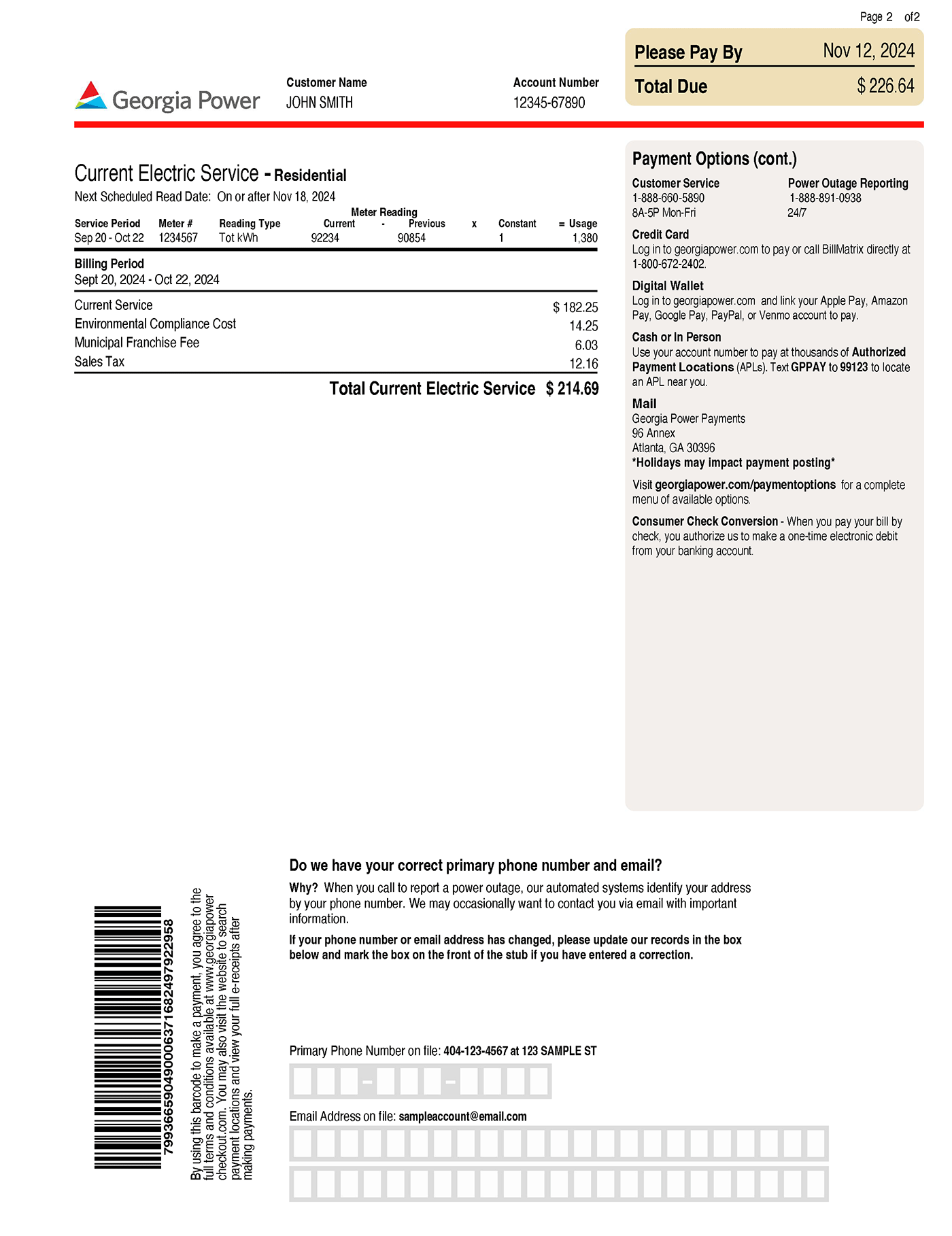

How do I read my bill?
Our interactive Residential Rate Sample Bill can help you make sense of the monthly charges, taxes and fees on your bill.
What does my Georgia Power bill pay for?

Service Charges
Basic Service Charge
Standard charge for receiving service. Covers administrative costs, metering costs, billing costs, and some distribution costs.
Energy Charge
The cost of the energy you used for that billing cycle, charged at the price per kilowatt-hour under your current rate plan.
Fuel Charge
Our fuel cost recovery charge to recoup our investment in the fuel used to generate your electricity.
Rate Case Adjustment
The Georgia Public Service Commission-approved amount we are allowed to recoup from additional costs we've incured due to market changes since our last rate plan filings.
Additional Charges, Taxes, and Fees
Environmental Compliance Cost
A charge to recover the cost of complying with state and federal environmental regulations.
Demand Side Management Cost
A charge toward our energy-saving efforts to increase efficiency and service reliability across the state.
Municipal Franchise Fee
A pass-through charge for us to utilize public roads, easements, and other public spaces to conduct our business.
Sales Tax
Standard state sales tax and additional local taxes.
Additional charges that may show up on your bill:
Demand Charges (specific to certain rate plans), Construction Financing Costs, and System Restoration Costs.
How It Works
Take a deep dive and learn why your bill looks the way it does!

How is my energy usage charged?
What is a kilowatt-hour (kWh)?
Energy is measured in Joules (J).
Watts (W) measures the rate of energy used at any given time. 1 Watt = 1 Joule per second.
Kilowatt-hours (kWh) measures the total amount of energy used over a period of time. 1 kWh = 1,000 Joules per second over an hour.
Different devices use energy at different rates. For example:
- Alarm clock (50W): 20 hours = 1 kWh
- Light bulb (100W): 10 hours = 1 kWh
- Dishwasher (2,000W): 30 minutes = 1 kWh
Why do we offer 7 different rate plans?
Everyone's energy habits are different. Some use more energy, others use less. Some use more energy during the mornings and evenings, others use more during the middle of the day. Some need energy in a constant demand, while others need energy in irregular bursts.
How much the energy cost to generate changes with the total demand (how much energy is required) across the entire electric grid – the higher the demand, the more generation resources are required, and the more expensive the energy becomes to produce and deliver to our customers. These fluctuations are known as On-Peak and Off-Peak demand periods.
Some of our rate plans are designed around these demand periods to incentivize people who can shift when they use energy to low-cost Off-Peak periods, while not punishing people who can't.
Other plans are more focused on offering predictability in how you go about paying for the energy you use. Want to pay a fixed price every month based on your homes average usage? Would you rather pay into your account balance and have funds deducted as you use energy?
Why is some energy usage more expensive?
The amount of energy we need to generate in order to cover the demand at any given time is called capacity.
Depending on which rate plan you're on, how you use energy may be just as important to your bill as how much you use and when you use it. To avoid spikes in sudden demand, some of our rate plans incentivize customers to spread out their usage by avoiding using multiple energy-demanding appliances, like washers and dryers, at the same time.
In this example: For the same amount of energy, the cost to serve Customer B is significantly higher as they

Customer A
Uses 500 kWh over 5 hours with a constant demand of 100 kW each hour.

Customer B
Uses 500 kWh over 5 hours but consumes all that energy in 1 hour at a demand of 500 kW.
| Year | Hour 1 | Hour 2 | Hour 3 | Hour 4 | Hour 5 |
|---|---|---|---|---|---|
| Hour 1 | |||||
| Hour 2 | |||||
| Hour 3 | |||||
| Hour 4 | |||||
| Hour 5 |
How flexible usage could lower your bill.
In another effort to lower the overall demand, our time-of-use rate plans also incentivize customers to use a majority of their energy during low-cost Off-Peak hours.
In this example both Customer A and Customer B are on the Overnight Advantage time-of-use rate plan which introduces an additional extra low-cost Super Off-Peak period overnight.
Customer A
Uses 30 kWh to charge an electric vehicle
Customer B
Uses 30 kWh to charge an electric vehicle
For the same amount of energy, Customer A
| Off-Peak | On-Peak | Off-Peak | Super Off-Peak |
|---|---|---|---|
| 7 a.m. - 2 p.m. $0.104 /kWh |
Off-Peak |
||
| 2 p.m. - 7 p.m. $0.303 /kWh |
On-Peak 30 kWh |
||
| 7 p.m. - 11 p.m. $0.104 /kWh |
Off-Peak |
||
| 11 p.m. - 7 a.m. $0.022 /kWh |
Super Off-Peak 30 kWh |
7 a.m.
Off
2 p.m.
On
30 kWh
7 p.m.
Off
11 p.m.
Super Off
30 kWh
Customer A
Uses 30 kWh to charge an electric vehicle
$0.656 /30 kWh ($0.022 /kWh)
Customer B
Uses 30 kWh to charge an electric vehicle
$8.936 /30 kWh ($0.298 /kWh)
For the same amount of energy, Customer A
Additional FAQs
Get the answers to some of the most commonly asked questions about why your bills might be higher.
Why have your rates gone up so much, so fast?
We are committed to making the long-term investments that will help to build a clean, reliable energy future for the state of Georgia. Some investments, like Plant Vogtle Units 3 & 4, ensure that our state has more options for always-on, carbon-free energy for the next 60-80 years. Other investments ensure that our grid is more reliable and resilient, like adding new battery energy storage systems, upgrading substations, and installing new power lines, poles, and smart devices that help minimize outages across our system.
Additionally, market increases to fuel costs and compliance with new environmental regulations have created higher operating costs that are reflected in our rates.
Is Georgia Power more expensive compared to other utilities?
Since 1990, Georgia Power customers have paid rates that are on average 15% below the national average rate.
We have a long history of keeping energy affordable, and we are committed to continuing this focus.
Why do rates go up in the summer, just when I'm likely to use more energy?
It costs Georgia Power more to produce and deliver energy in the summer when demand is highest. As a result, the first 650 kWh used by customers each month cost slightly more during the hotter summer months than during the rest of the year.
What is Georgia Power doing to keep my rates down?
We work with the Georgia Public Service Commission to help ensure that our long-term planning decisions align with our commitment to deliver clean, safe, reliable, and affordable energy to every customer.
While our costs of doing business have increased, we help offset this by reducing operational expenses, managing storm cost recovery, and making smart financing decisions.
Why is my Georgia Power bill so high in the summer?
There are a combination of factors that influence the amount on your power bill – mostly how much energy you use and the cost of electricity. However, in the summer months (especially in the southeastern states), many people and businesses use more electricity to keep cool due to hot weather and high humidity.
What causes my bill to increase in the winter?
Your energy usage may likely higher in the winter because you use your heating system more frequently and for longer periods to maintain a comfortable indoor temperature, which consumes a significant amount of energy.
I’ve heard Georgia Power is making record profits? How is that fair when my bill is so high?
Under our state-regulated structure, what we are allowed to earn, our profit, is capped by the Georgia Public Service Commission. If we exceed this capped amount, funds are returned for the direct benefit of customers.


