

Our solutions offer more than just resiliency.
Severe weather or other disruptions to electric service can be catastrophic to daily operations. Distributed Energy Resources (DER) such as small-scale turbines and gas generators provide flexibility and peace of mind. We offer a range of DER programs designed to enhance resiliency, provide customer credits, and support grid reliability.
Offset your costs while avoiding downtimes and staying powered through emergencies!

Flexible Options
Participation ranges from 50 hours to up to 400 hours of operational dispatch per year.

Have Existing Equipment?
Tier 2 diesel generators and other emergency-use assets may qualify.
System Ownership Options
Georgia Power Full Service Solutions
- We design the backup-generation solution tailored to your business.
- We procure and install the DER assets.
- We own, operate, and maintain the DER assets.
Customer Owned Solutions
Our co-managed program options are designed to give you more control:
- You own and maintain the DER assets.
- Asset operational control varies by program.
System Peak Event Incentives
Interconnected Grid Pushing
Help increase our capacity by pushing energy from the DER assets to the grid.
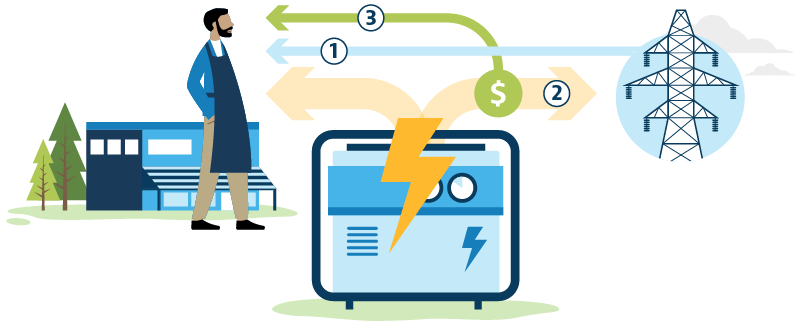
Your facilities will remain supported by 1 energy from the grid, but during a system peak event your DER assets would 2 assist the grid in exchange for 3 energy credits.
Credits maximized based on size of asset.
Standalone Load Reducing
Help lowering the overall load by reducing your dependency on the grid.
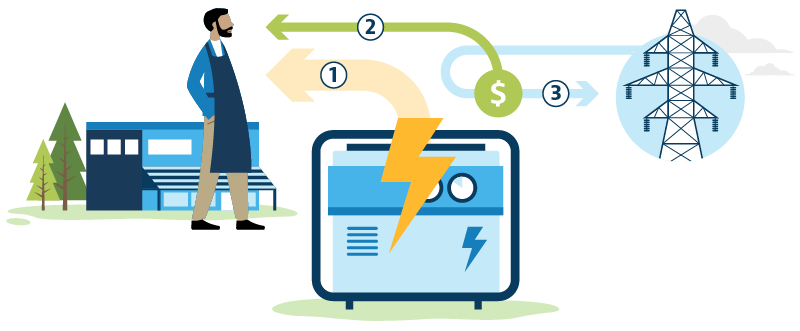
During a system peak event your facilities would 1 shift usage onto the DER assets, in exchange for 2 energy credits based on the 3 energy returned to the grid.
Credits maximized based on firm load.
Georgia Power's DER Program Solutions
DER Colocation Program
Grid Pushing Incentive
Georgia Power own and maintain assets
Incentive: Receive an upfront credit of 75% of the system's capacity value.
Perfect for: Large customers with capital to invest in DER assets.
Asset must have a capacity 10 MW or more.
DER Customer Pilot Program
Load Reducing Incentive
Georgia Power own and maintain assets
Incentive: Offset system costs via a credit valued at 100% of your firm capacity reduction.
Perfect for: Customers with limited capital availability, prefer program payments on energy bill.
Customer minimum peak load must be 200 kW to participate in program.
Customer must have 1000 kW of load to qualify for demand reduction credit.
DER Customer Owned Program
Grid Pushing Incentive
Customer own and maintain assets
Incentive: A fixed credit added to your monthly bill based on 75% of the system's capacity value.
Perfect for: Small and medium-sized customers with available capital, want ownership of DER assets and optional separate meter.
Asset must have a capacity between 1-10 MW.
Customer Owned Demand Response Programs
Load Reducing Incentive
Customer own and maintain assets
Incentive: Customers receive 75% of the value of load that can be shifted to DER assets during a system peak event.
Large Customer Owned Resiliency Program
Perfect for: Customers with available capital and want to retain ownership of
Curtailable Load Program
Perfect for: Customers who can lower their load regardless of asset availability or asset age.
Programs Details
Georgia Power Owned Grid Pushing
DER Colocation Program (DCL)
A grid pushing program through which new Georgia Power-owned, dispatchable large DER systems will be made available to qualifying C&I customers to support resiliency. This program is implemented under the DER Colocation Tariff (DCL-1). View Tariff PDF
| DER Asset Ownership | Georgia Power |
| Capable of pushing to the Grid | Yes |
| DER Metered Separately | Yes |
| Max Term Length | Asset Life |
| Technology Allowed | Dispatchable with Firm Fuel Supply |
| Eligibility | Installed asset nameplate ≥ 10MW |
| Program Tariff Cost / Credit | Capital and O&M - 75% of system value = Lump sum upfront payment |
| Fuel Cost Responsibility | Georgia Power |
| Operational Use Cases | Local Outage, Economic Dispatch |
| Rate limitations | No limitations |
Program Details:
- Georgia Power will design, procure, install, own, operate, and maintain a dispatchable DER with a firm fuel supply and are interconnected allowing us to transmit the produced energy to the electric grid.
- The DER system provides the customer with backup service and will be dispatched by Georgia Power to support both economic and reliability needs on its system.
- Participating customers will pay an upfront lump sum payment that is determined based on the total investment plus projected maintenance and operating costs less 75% of the system value.
Eligibility Requirements:
- System must be at least 10 MW and located at customer premises.
- Participants must enter a customer agreement that identifies the scope, pricing, and commercial terms.
- An interconnection agreement will be required. Costs for studies and required equipment and installation will be the responsibility of the customer.
Georgia Power Owned Load Reducing
DER Customer Pilot Program
A behind-the-meter DER Customer Pilot Program, which is implemented under two complementary tariffs: the Resiliency Asset Service Tariff (RAS-1) and the Demand Response Credit Tariff (DRC-1).
| DER Asset Ownership | Georgia Power |
| Capable of pushing to the Grid | No |
| DER Metered Separately | No |
| Max Term Length | Asset Life |
| Technology Allowed | Dispatchable |
| Eligibility | RAS: 200kW Annual Peak Load DRC: 1000kW Demand Reduction but can aggregate facilities if each is > 200kW |
| Program Tariff Cost / Credit | Monthly levelized payment & credit RAS: Capital and O&M Costs DRC: 100% Capacity Value (Firm Load Only) |
| Fuel Cost Responsibility | Customer |
| Operational Use Cases | Local Outage, Extreme Supply and Demand Conditions |
| Rate limitations | Certain marginal rates ineligible |
Resiliency Asset Service (RAS)
Tariff Details:
- Georgia Power will design, procure, install, own, operate, and maintain the equipment and charge the customer a fixed monthly payment.
Eligibility Requirements:
- 200kW Annual Peak Load required.
Demand Response Credit (DRC)
Tariff Details:
- Georgia Power offers a credit for demand response that allows us to dispatch the resource through operation of the DER during a system reliability event.
- Participating customers can receive a fixed monthly credit valued at 100% of the capacity value.
- Customers enrolled in RAS-1 have the option to participate in the DRC-1.
Eligibility Requirements:
- Customers can aggregate multiple accounts under the same corporate ownership to reach the 1,000 kW minimum so long as the minimum peak demand at each premises is at least 200 kW. A single point of contact designated by the customer will also be required.
- Participants must enter into respective customer agreements that identifies the scope, pricing and commercial terms.
- To participate in DRC-1, RAS-1 participation is required and a minimum of 1,000 kW of demand reduction must be achieved.
- Must not be on the following rate plans or schedules to participate in DRC-1: FPA, EAF, DPEC, TOU-SC. Customers on Real Time Pricing have certain restrictions based on their firm load.
Customer Owned Grid Pushing
DER Customer Owned Program (DCO)
A grid pushing program through which customers can enroll their new DER systems for a monthly credit, implemented under the DER Customer Owned Tariff (DCO-1). View Tariff PDF
| DER Asset Ownership | Customer |
| Capable of pushing to the Grid | Yes |
| DER Metered Separately | Yes |
| Max Term Length | Up to 15 years |
| Technology Allowed | Dispatchable with Firm Fuel Supply |
| Eligibility | Installed asset nameplate ≥ 1MW and < 10MW, can aggregate if each is 250kW or greater |
| Program Tariff Cost / Credit | Monthly levelized credit for 75% of the system value |
| Fuel Cost Responsibility | Georgia Power |
| Operational Use Cases | Local Outage, Economic Dispatch |
| Rate limitations | No limitations |
Program Details:
- Georgia Power will operate and control new, customer-owned, dispatchable DERs with firm fuel supply and are interconnected, allowing us to transmit the produced energy to the electric grid.
- An interconnection agreement will be required. Costs for studies and required equipment and installation will be the responsibility of the customer.
- The DER provides the customer with backup service and will be dispatched by Georgia Power to support both economic and reliability needs on its system.
- Participating customers will receive a monthly credit based upon 75% of the system value that the DER provides at the time of contracting.
- Customers can currently participate for up to 15 years. At term end, Georgia Power and the customer may extend the agreement based on system needs.
Eligibility Requirements:
- System must be between 1 MW and 10 MW and located at customer premises. Customers may aggregate assets at multiple accounts to meet the 1 MW minimum requirement, provided that each account’s DER is 250 kW or greater.
- Participants must enter a customer agreement that outlines the requirements of the customer resource, including, but not limited to design, installation, operations, maintenance, and permitting.
Customer Owned Load Reducing
Large Customer Owned Resiliency Program (LCOR)
A behind-the-meter program through which customers can enroll their new DER system for a contracted value, implemented under the Large Customer Owned Resiliency Tariff (LCOR-1). View Tariff PDF
| DER Asset Ownership | Customer |
| Capable of pushing to the Grid | No |
| DER Metered Separately | No |
| Max Term Length | Up to 15 years |
| Technology Allowed | Dispatchable with firm fuel supply |
| Eligibility | No size restrictions, transmission connected preferred |
| Program Tariff Cost / Credit | Credit of 75% of the levelized value of customer's demand reduction |
| Fuel Cost Responsibility | Customer |
| Operational Use Cases | Local Outage, Peak Shaving, Extreme Supply and Demand Conditions |
| Rate limitations | Certain Marginal Rates Ineligible |
Program Details:
- Georgia Power’s Large Customer Owned Resiliency Program (LCOR-1) enables commercial and industrial customers to leverage their own DERs for enhanced resiliency and grid support.
- This program rewards customers who maintain and operate their own backup generation while allowing Georgia Power to dispatch those resources during system reliability events.
Eligibility Requirements:
- Must be dispatchable.
- Must have a firm fuel supply.
- Must be available during grid events.
- Must meet Georgia Power's minimum technical requirements.
- Must not be on the following rate plans or schedules to participate in DRC-1: FPA, EAF, DPEC, TOU-SC. Customers on Real Time Pricing have certain restrictions based on their firm load.
Load Reducing No New Assets Required
Curtailable Load Program (CL)
A demand response program through which customers can enroll to receive monthly credits for load curtailment. View Tariff PDF
| DER Asset Ownership | Customer (if DER installed) |
| Capable of pushing to the Grid | No |
| DER Metered Separately | No |
| Max Term Length | Up to 6 years |
| Technology Allowed | No requirements |
| Eligibility | At least 200kW firm load demand reduction |
| Program Tariff Cost / Credit | Custom Calculation |
| Fuel Cost Responsibility | Customer |
| Operational Use Cases | Local Outage, Peak Shaving, Extreme Supply and Demand Conditions |
| Rate limitations | Certain Marginal Rates Ineligible |
Program Financials:
- Customized monthly credit based on customer’s hourly firm load, and their ability to curtail during system need. Higher values are assigned to customers who can curtail during utility peak months.
Program Details:
- Georgia Power’s Curtailable Load Program (CL-1) is designed for commercial and industrial customers who can reduce their electricity usage during peak demand periods. By participating, customers help enhance grid resiliency and receive financial incentives for their flexibility.
- Georgia Power will notify participants at least 30 minutes in advance of a curtailment event.
- A DER asset is not required to participate in the CL program.
Eligibility Requirements:
- Available to customers with at least 200 kW of demand reduction capability.
- Requires a signed Curtailable Load (CL) Customer Agreement with Georgia Power.
- Customers on certain rate schedules (e.g., FPA, EAF, DPEC, DRC, TOU-SC) are not eligible unless subject to specific billing requirements. RTP rate has certain restrictions tied to firm load.
- Annual demonstrations are required to verify compliance.
Frequently Asked Questions
What are the key advantages for customers that participate in these programs?
Participating customers will have readily available resiliency options at hand in the event of an outage at more affordable rates. The utilization of resources will result in a credit on placed on the customer’s monthly bill. Contract term and start date can affect the credit value. Georgia Power will handle the installation and maintenance of equipment, ensuring reliability of our resources.
What types of resources are offered under these programs to provide resiliency?
Georgia Power's initial approach to resiliency is to provide customers with dispatchable backup resources such as traditional reciprocating internal combustion engines that utilize diesel or natural gas fuel as well as battery energy storage systems.
How will my operations be affected when the resource is running?
In the event of an electrical service interruption, the asset will turn on automatically to restore electricity within 60 seconds (and maybe less depending on the specific equipment installed). If there is no service interruption and Georgia Power is operating the resource for normal testing or to support grid reliability, the resource will be designed for an uninterrupted, seamless transfer from the grid to the generator and back.
Where will the resource(s) be installed?
The installation location will be specific to each customer, but in general the resource will be installed on the participating customer’s premises behind or in front of the utility meter.
What if I move my facilities or close them before the end of the 20 years?
The service agreement between Georgia Power and the customer will include termination provisions that address specific scenarios. In the case of a customer ceasing to take electric service from Georgia Power during the term of the agreement, the financial obligations identified in the contract must still be satisfied for the remaining costs associated with the generator under the contract. In the case of a change in ownership or tenancy of the facility, a transfer of responsibility to the new owner or tenant may take place with Georgia Power’s approval.
What if I already own a generator?
Under the Curtailable Load Program, customers may participate with assets that they already own. The asset will be subject to local air permitting and runtime laws. All other programs require new generators. Any generators that have previously been operated or are already online will not be able to participate.
What equipment will be installed in the Georgia Power Owned options?
Each solution is intended to be customized to serve the resiliency needs of the individual customer, however most systems are expected to include the following:
- Dispatchable multi-hour operational resource (typically diesel or natural gas back-up generator or battery energy storage system) with enclosure.
- Controls gateway for remote monitoring and dispatch electric connections to tie-in to the facility.
What is normally included in the cost of installation?
- Hardware (generator, ATS, gateway, etc.) installation
- Civil site work (dirt work, concrete pad)
- Electrical wiring and conduit from resource to your facility
- Mechanical components (ex. natural gas piping to the resource)
- Labor costs (installers, contractors, oversight)
- Transport and logistics
- Equipment siting (crane or lifts) for installing larger components
What do you need to know about my business to size the resource?
We need to know how much of your peak load you intend to serve with this resource. While we can estimate the appropriate size of a generator based on your company’s power usage, to properly size your generator we will want to determine your resiliency needs and a few other technical factors including the types of equipment and their electrical characteristics such as in-rush current. It is also important for us to know about any electrical need changes expected whether through new equipment or business expansion.
How do I know it will be safe when you turn on my generator remotely?
The generator will be enclosed and monitored when operating automatically. When operating for testing the resource will be on a standard schedule, so all parties know when to expect them to be turned on. In the case of operation for system reliability events, the customer will receive a notification 30 minutes in advance of the resource being turned on.
What can I expect of maintenance and repairs on the generator in the Georgia Power Owned options?
Maintenance and repairs of the generator are included in this program. Maintenance and repairs will be conducted by Georgia Power employees and maintenance partners in accordance with the manufacturer recommendations to ensure reliability when it is needed. While the specifics of maintenance will vary by size and manufacturer, it generally includes items such as inspections, oil and filter changes, and replacements of seals, spark plugs, fuses, belts, hoses, and batteries. Operation of the resource will occur at periodic intervals (ex. weekly, bi-weekly, or monthly depending on the equipment requirements) to ensure proper operation when needed. The expected run time generally precludes the need for any major overhauls during the term of the service agreement.
What will I need to pay for with the Customer Owned program?
Customers will be responsible for buying and owning their DER systems. They will also be responsible for any interconnection upgrade costs. This includes study fees and any related system upgrades.
Can I peak shave with these programs?
You can peak shave with the LCOR and CL programs. With all other programs, peak shaving is not allowed.
Large Customer Owned Resiliency Program
Load Reducing Incentive
Customer own and maintain assets
Incentive: Get a credit of 75% of the value of your load that can be shifted to DER assets during a system peak event.
Perfect for: Customers with available capital and want to retain ownership of new DER assets.
Asset must be able to serve the customer’s energy requirements during a demand response event.
Curtailable Load Program
Load Reducing Incentive
No Assets Required
Incentive: Get a credit of 75% of the value of the energy usage you can reduce by during a demand response event.
Perfect for: Customers who can lower their load regardless of DER asset availability or asset age.
No capital outlay required.


