

Save by spreading out your energy usage.
Our Smart Usage rate plan is designed to give you more control over your bill based on when and how you use energy.
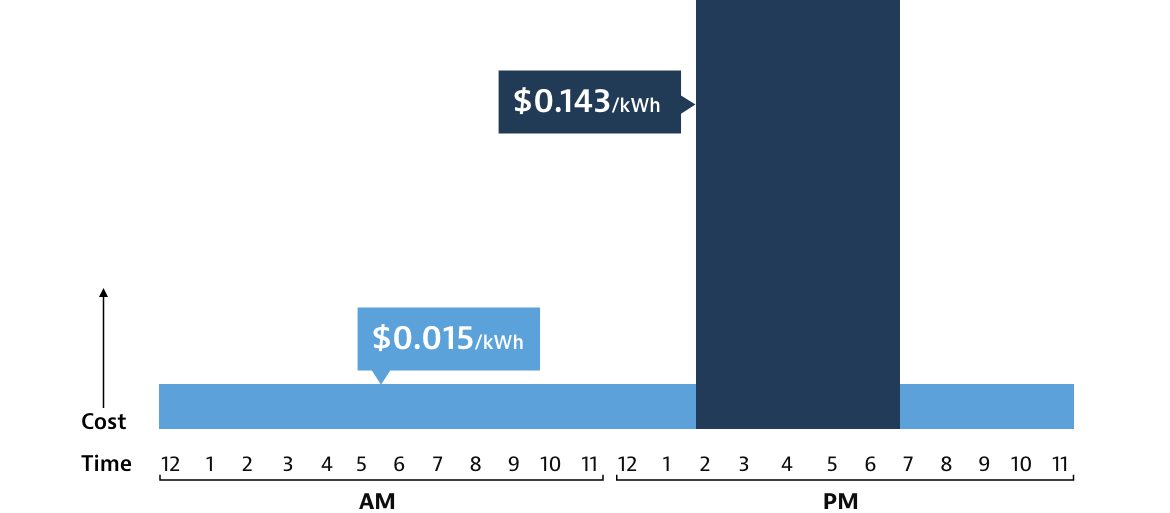
Compared to our other rates, Smart Usage charges lower prices for energy during both On-Peak and Off-Peak periods, but introduces a demand charge for the highest single usage hour every month.
Example:
Electric appliances, like clothes dryers, ovens, and dish washers, are some of the biggest energy users in most homes. By spreading-out when you run these appliances, instead of running them at the same time, you can reduce your overall demand and lower your bill.
What is On/Off-Peak?
Since energy demand is higher during the hot summer months (June – September), generating electricity during this time costs more. This period is called On-Peak pricing and runs from 2 p.m. to 7 p.m. on summer weekdays, excluding holidays.
Off Peak pricing occurs during all hours not included during the on-peak period including all weekends, Independence Day, and Labor Day.
Since the electricity during Off-Peak hours is cheaper to generate we can pass those savings on to customers by offering lower rates during this time.
Seasonal Pricing Periods
Off-Peak Pricing:
$0.016 per kWh
All hours not included during On-Peak period.
Summer On-Peak Pricing:
$0.146 per kWh
Only active June-September
Monday-Friday | 2 p.m. - 7 p.m.
What is the 1-Hour Monthly Demand Charge?
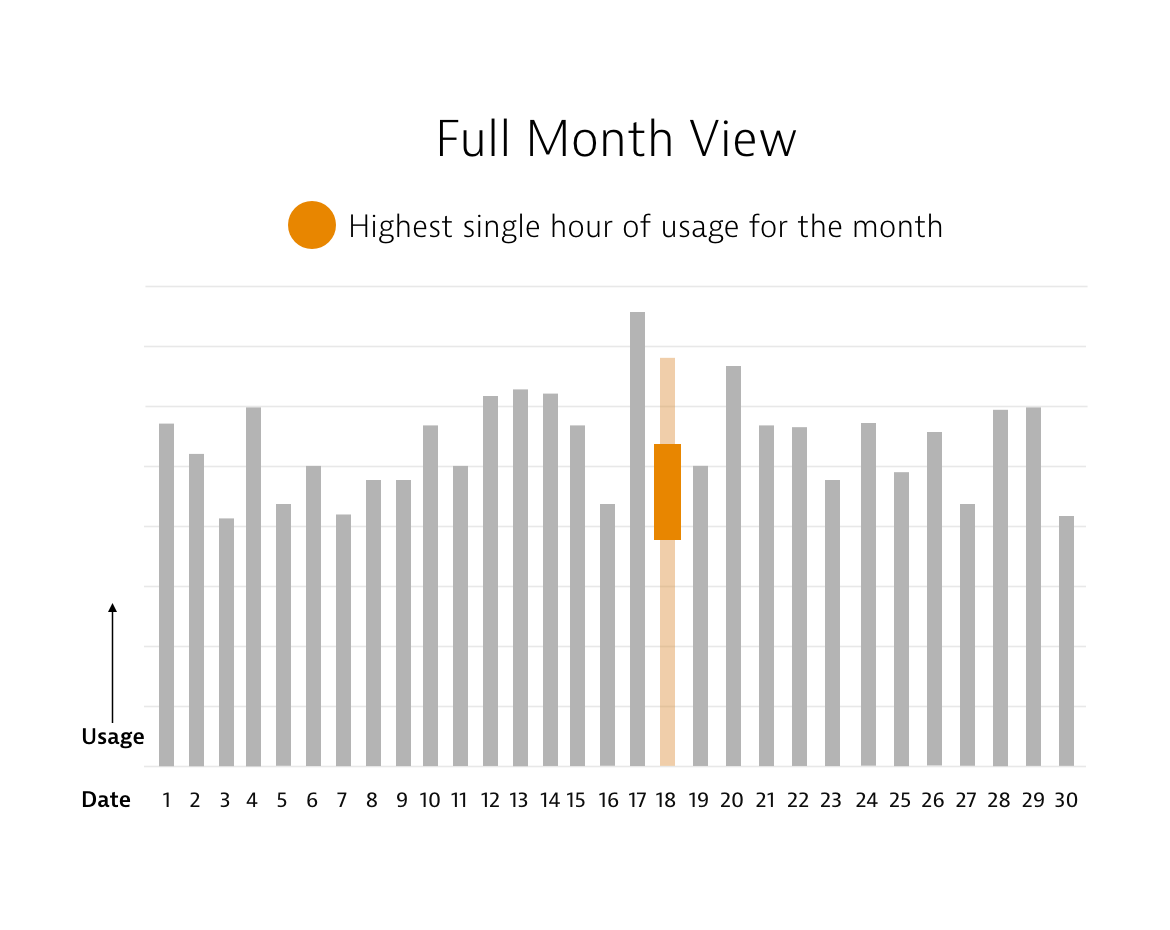
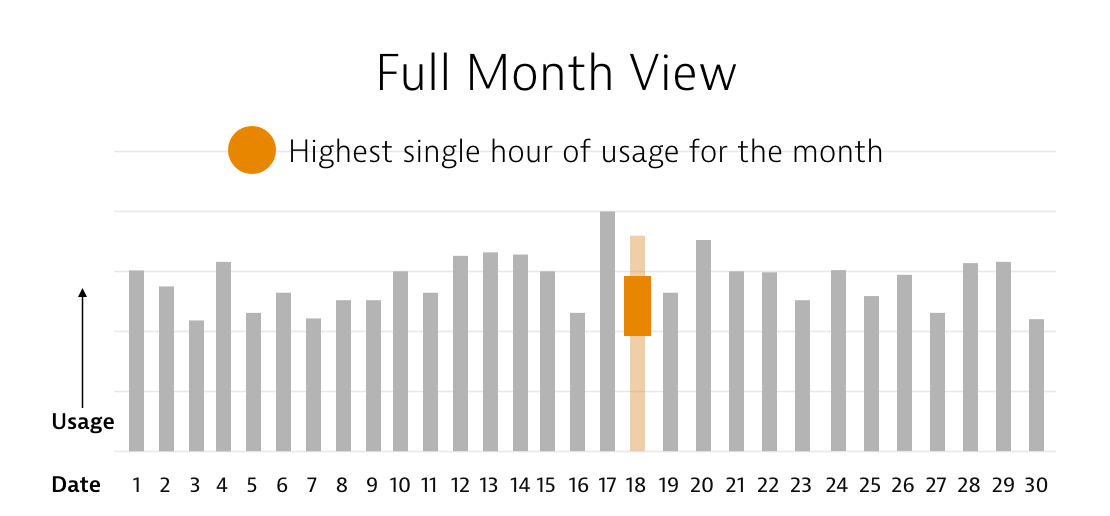
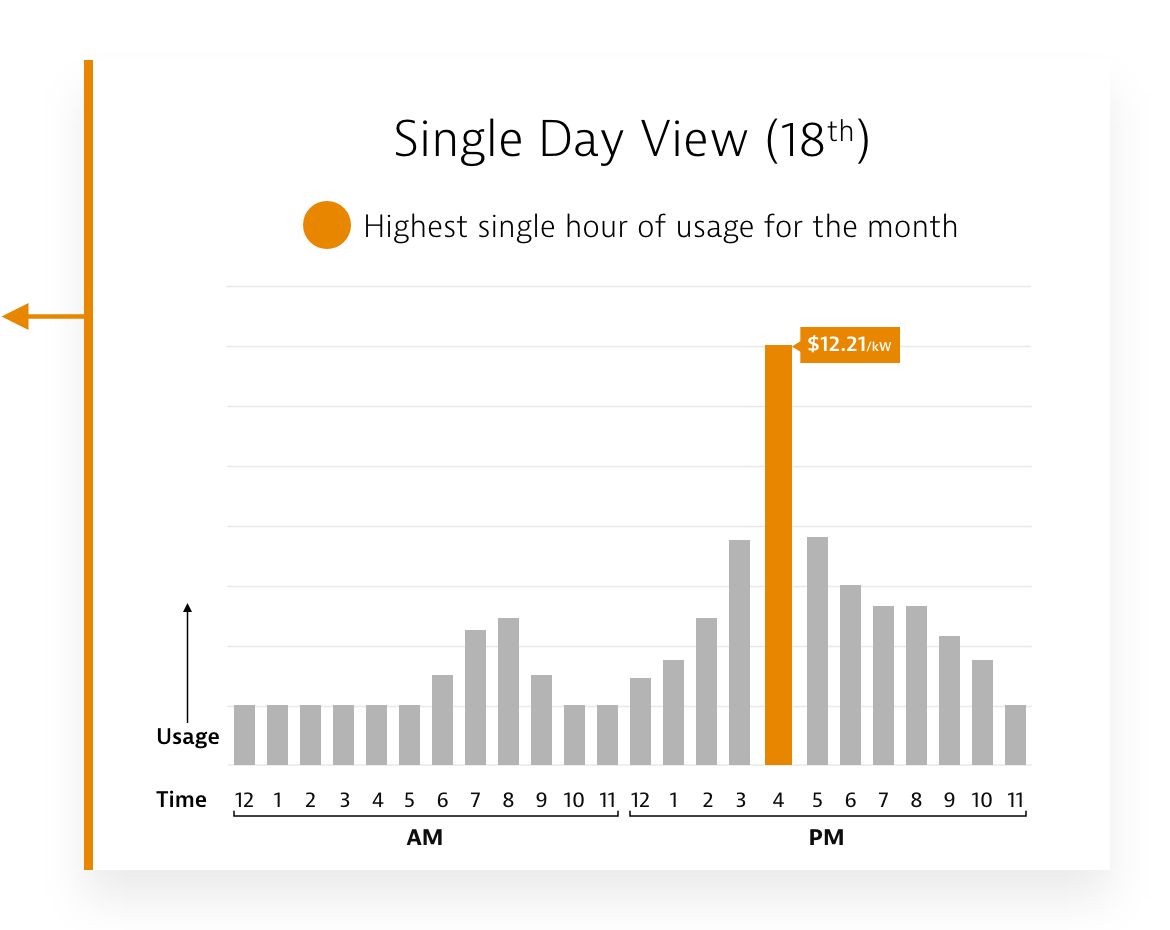
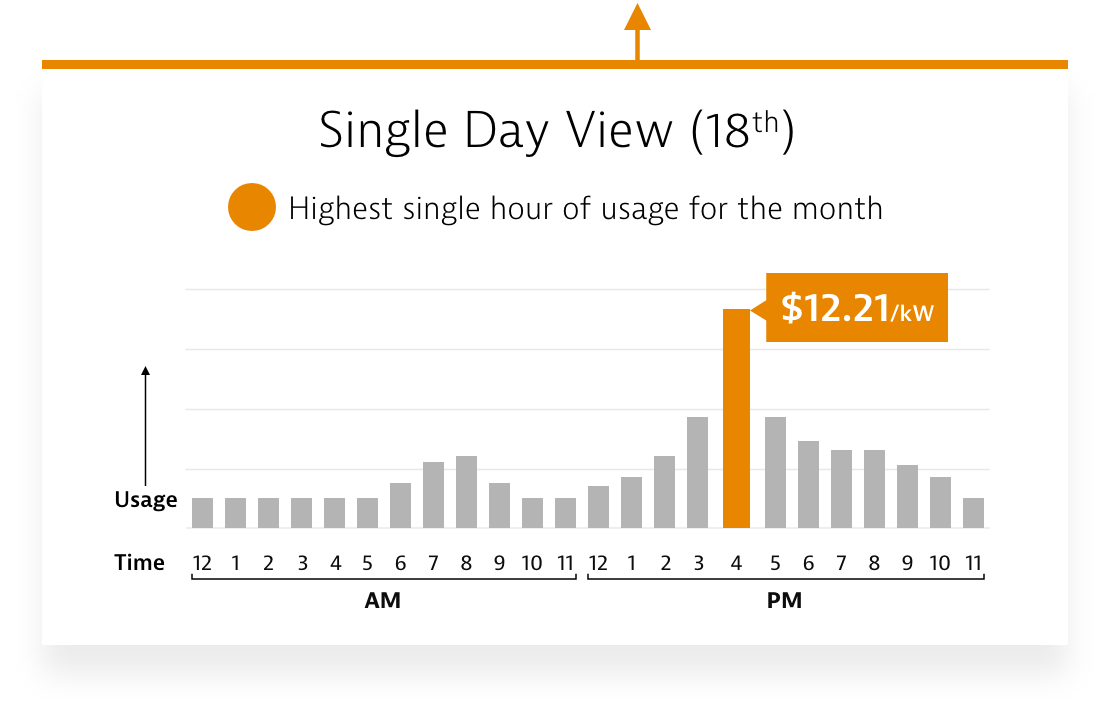
The energy used during the single hour of highest usage for the month is charged at a special Demand rate of $12.44 per kW.
Often this usage is driven by your HVAC system, water heater, or running multiple appliances at the same time.
In the example below, the single hour with the most energy used for the full month was between 4 p.m. - 5 p.m. on the 18th.
Not sure if this rate is right for you?
Rate Plan Details
- Smart Usage
- Compare to Similar
|
Commitment Agreement:
12 months |
|
Account Activation: $30 New Account Establishment Fee |
|
On-Peak Pricing:
${{onPeakPricingValues.[0]}} per kWh June-September | M-F | 2:00p - 7:00p ${{offPeakPricingValues.[0]}} per kWh All hours not included in the On-Peak period, including all weekends, July 4th, and Labor Day. ${{monthlyDemandChargeValues.[0]}} per kW Applied to the highest usage hour in a monthly bill cycle. |
|
Payments: All payment options available |
|
Budget Billing Available?
Yes |
|
Limitations: None |
Scroll within table below to compare rate plan details
 Smart Usage
|
 Overnight Advantage
|
 Nights & Weekends
|
|---|---|---|
|
Spread out when and how you use energy to decrease your monthly Peak Demand—peak power usage over one hour. |
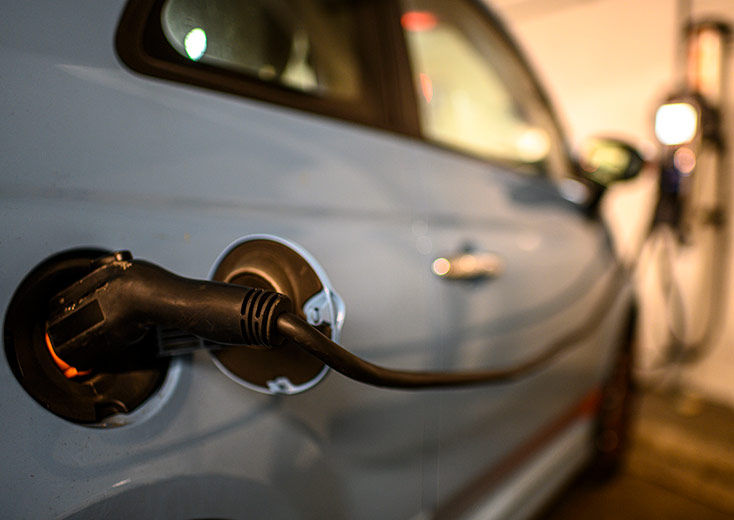
Save money by shifting your electric usage, electric vehicle charging, or home battery charging to overnight. |
Shift summer usage to off-peak hours to make this plan work for you. |
| Attributes: On-Off Peak Pricing Seasonal Rate Monthly Billing | Attributes: On-Off Peak Pricing Monthly Billing Seasonal Rate | Attributes: On-Off Peak Pricing Monthly Billing Seasonal Rate |
|
On-Peak Pricing:
${{onPeakPricingValues.[0]}} per kWh June-September | M-F | 2:00p - 7:00p ${{offPeakPricingValues.[0]}} per kWh All hours not included in the On-Peak period, including all weekends, July 4th, and Labor Day. ${{monthlyDemandChargeValues.[0]}} per kW Applied to the highest usage hour in a monthly bill cycle. |
On-Peak Pricing:
${{onPeakPricingValues.[0]}} per kWh June-September | M-F | 2:00p - 7:00p ${{offPeakPricingValues.[0]}} per kWh All hours not included in the On-Peak or Super Off-Peak periods, including all weekends, July 4th, and Labor Day. ${{superOffPeakValues.[0]}} per kWh Everyday | 11:00p - 7:00a |
On-Peak Pricing:
${{onPeakPricingValues.[0]}} per kWh June-September | M-F | 2:00p - 7:00p ${{offPeakPricingValues.[0]}} per kWh All hours not included in the On-Peak period, including all weekends, July 4th, and Labor Day. |
|
Commitment Agreement: 12 months |
Commitment Agreement: 12 months |
Commitment Agreement: 12 months |
|
Account Activation:
$30 New Account Establishment Fee |
Account Activation:
$30 New Account Establishment Fee |
Account Activation:
$30 New Account Establishment Fee |
|
Payments:
All payment options available |
Payments:
All payment options available |
Payments:
All payment options available |
|
Budget Billing Available?
Yes |
Budget Billing Available?
Yes |
Budget Billing Available?
Yes |
|
Limitations: None |
Limitations: None |
Limitations: None |
View
Smart Usage Disclaimer
How Rate Plans Impact Your Bill
What you're charged for your energy usage under your rate plan makes up a part of the Current Service charge on your bill. It includes a Basic Service Charge and an Energy Charge, but does not account for things like Fuel Costs or additional taxes and fees.
Learn more about the charges on your bill
How Changes to Rate Plans are Decided
All rate plans are subject to change through our Regulatory Filings, including pricing details and payment structures, if approved by the Georgia Public Service Commission.
Please consult the full Smart Usage Tariff Details (PDF) for all details pertaining to this rate plan.
Take advantage of these options while on the Smart Usage rate plan:
Auto-Pay
Never miss a payment. Set up Auto-Pay and have your balance drafted automatically.
Budget Billing
No surprises. Standardize the amount you pay each month based on your average yearly usage.

Paperless Billing
Receive and review your bill online, and cut down on the clutter. Signing up is FREE and easy.
Frequently Asked Questions
General FAQs
What are demand charges?
Smart Usage customers are charged $12.44 per kW during the highest usage hour during a billing period. This charge incentivizes Smart Usage customers to plan when and how they use energy.
For example, if the most energy you consume during a 60-min kW measurement in a month is 4.5 kwh, then your demand charge would be $55.98 or to $12.44 * 4.5.
What is "demand" and how does it relate to energy?
When speaking about electrical energy, there are two related, yet different, measurements: consumption (kilowatt-hours, or kWh) and demand (kilowatts, or kW).
Energy consumption is the total amount of electricity used over a specified period. Demand is the immediate rate of that consumption.
- Energy and demand are related like your car's distance and speed. Measuring how far you have traveled is different from the speed you traveled.
- For example: Driving two hours at 60 miles per hour, you traveled 120 miles (miles = kWh) at 60 miles per hour (speed = kW).
How does the Smart Usage rate compare to the standard residential rate?
- The residential rate measures and charges only for the energy used (consumption).
- The Smart Usage rate charges a lower rate for energy and adds demand component.
What is the difference between the Smart Usage rate and Nights and Weekends?
Both pricing plans encourage customers to shift energy usage away from the on-peak time periods (2–7 p.m., Monday–Friday, June–September, excluding holidays). The on-peak and off-peak rates are less for the Smart Usage rate because of the addition of the demand component.
What's my demand?
Household demands vary. The average Georgia home uses approximately 7 kW of maximum demand per month. Of course, your household's demand could be larger or smaller than the average. The size of your home, number of air-conditioning units, and the fuel type of your furnace will have the largest impact on your maximum demand. If you stagger the use of some large appliances, you can manage and potentially reduce your demand.
Do I have to go on this rate?
No. The Smart Usage pricing plan is an optional rate.
Eligibility FAQs
Why is Georgia Power offering this rate?
With advancements in Smart Meter technology, we can now measure and bill residential customers for demand. This provides better price signals to you and gives you more ways to control your bill. These price signals encourage the most efficient utilization of Georgia Power's electrical system.
If I switch to the Smart Usage plan, how long do I have to stay on it?
You must commit to stay on the Smart Usage pricing plan for at least 12 months.
Can I be on Budget Bill and the Smart Usage pricing plan?
Yes, you can be on Budget Bill while on the Smart Usage plan. However, the account must bill one month on Smart Usage before Budget Bill can be established.
Billing & Payments FAQs
Can you explain the charges on Smart Usage?
Energy is measured in kilowatt-hours (kWh); it is based on the total amount of energy used during an entire monthly billing cycle. This is similar to your car odometer measuring how many miles you have traveled.
| OFF-peak kWh (all hours not ON-peak) |
ON peak kWh (June-September, 2 p.m. - 7 p.m., weekdays) |
|---|---|
| $0.016/kWh1 | $0.146/kWh1 |
Maximum demand is measured in kilowatts (kW) and is based on your home's highest usage of power in any 60-minute period during the monthly billing cycle. This is similar to your car speedometer measuring how fast you are traveling.
| Max Demand (all months of the year) |
|---|
| $12.44/kW1 |
1please note: Prices based on TOU-RD-11 and do not include Basic Service Charge, fuel, environmental, taxes and other charges.
Will I save money on this rate?
Unfortunately, we are not able to predict whether an individual customer would save money on the Smart Usage rate. We can tell you that the pricing plan can help customers who are able to avoid simultaneous use of clothes dryer and cooking appliances. An additional way to save is to shift other energy usage, such as air conditioning, from peak hours (2 p.m. - 7 p.m., weekdays excluding holidays, June - September) to off-peak hours.
Is it possible to have a higher bill?
Yes, it is possible, if you are unable to avoid staggering the usage of higher-demand appliances or if much of your energy usage is during on-peak hours. You can also refer to the table of electric appliances to see what appliances use more demand than others. Remember, the fewer you use at the same time, the more money you could save.
Terms & Conditions
- By choosing to participate in the residential Smart Usage rate plan, you agree to pay the monthly Smart Usage charges for electric service to the service address associated with the account number used in online enrollment for at least twelve months, beginning with the first bill rendered on the Smart Usage rate.
- Your Smart Usage rate does not include fuel, taxes, and other charges, nor does it include Georgia Power security lights, or other Georgia Power products and services should you have any.
- These Smart Usage terms apply only for electric service to the designated account(s) and address. If you transfer service to another address, you will need to reapply for the Smart Usage rate.
- Georgia Power offers the Smart Usage rate plan pursuant to the current residential rate filing, which is on file with the Georgia Public Service Commission.


