
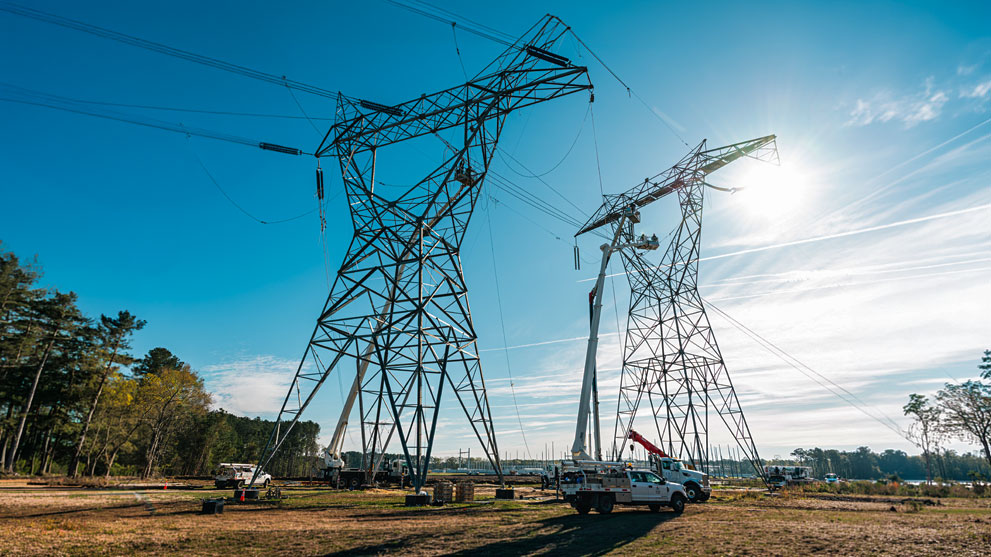
Strengthening the grid that powers your everyday life.
Transmission lines and substations help deliver electricity from where it is generated to the homes and businesses that depend on it every day. By upgrading existing infrastructure and building new connections, we are strengthening the grid, supporting Georgia’s growing energy needs, and working carefully within the communities we serve. This page shares why these projects matter, what you may see along the way, and how we stay connected with customers and neighbors throughout the process.
10 Year
Transmission strategy
1,000 Miles
New transmission lines
4,000 MW
BESS approved by Public Service Commission
Georgia's Growing Energy Needs
How We’re Preparing the Grid for Georgia’s Future
Georgia’s energy needs are changing as the state continues to grow, and transmission planning takes place years in advance to ensure the electric grid is ready to serve homes, businesses, and new industries. We are building the future of energy by investing in a stronger and more resilient grid designed to support Georgia’s energy needs today and well into the future.
These investments help ensure dependable service today while positioning Georgia to meet future energy needs safely and efficiently.
Upgrading Existing Lines
Replacing Aging Equipment
Replacing aging equipment is essential to prevent failures, reduce maintenance costs, and ensure the continuous and reliable delivery of electricity.
Increasing Capacity
Upgrading lines with advanced technology boosts capacity, meeting growing demand without building new infrastructure.
Building New Transmission Lines
Enhancing Flow and Reliability
New transmission lines optimize the electrical system flow, allowing for greater efficiency and reliability of energy distribution.
Connecting Remote Renewables
New transmission lines connect renewable sources to the grid, advancing clean energy initiatives and promoting sustainability.

Adding New Substations
Supporting Load Growth
New substations support growing electricity demand, maintaining grid reliability.
Enhancing Grid Flexibility
Substations also increase grid flexibility, enabling better power flow, renewable integration, and demand response.
Statewide Investments
Current Projects
Learn more about specific project timelines, what to expect in your area, and how we communicate during the process.
| Project Name | County/Region | Type |
|---|---|---|
| Cash Creek - McGrau Ford 500 kV | Banks, Dawson, Habersham, Hall, & Lumpkin counties | New Transmission Line |
| Tomochichi - Towaliga River 230 kV | Butts & Spalding counties | Area Project |
| Big Tazewell - Farley 500 kV | Chattahoochee, Clay, Early, Marion, Quitman, & Stewart counties | New Transmission Line |
| Decatur - Scottdale 115 kV | Dekalb County | Transmission Line Upgrade |
| Callaway Road - Thomson Primary 500 kV | Columbia & McDuffie counties | Area Project |
| Effingham County 500 kV | Effingham County | Area Project |
| Hills Bridge – Speedway 500/230 kV | Clayton & Henry counties | New Transmission Line |
| Grassy Hollow – Great Valley 230 kV | Bartow County | New Transmission Line |
| Hatch – Wadley Primary 500 kV | Appling, Emanuel, Jefferson, & Toombs counties | New Transmission Line |
| Conyers – Klondike 230 kV | Dekalb & Rockdale counties | New Transmission Line |
| Ashley Park – Wansley 500 kV | Fayette & Heard counties | New Transmission Line |
How Projects Move Forward
Project Timeline
Our investment in the statewide transmission system spans many years, with most projects currently in the planning stages. While each project has its own schedule, all transmission projects follow the same general phased approach. These phases require careful coordination, and timelines may change based on permitting requirements or community considerations.

Phase 1
Planning
Early engineering work and route studies take place during this phase. Projects may remain in planning for several years before construction begins.
Phase 2
Permitting
Environmental reviews are completed during this phase. The process includes coordination with state and federal agencies and engagement with stakeholders and local communities.
Phase 3
Under Construction
Work is actively taking place in the field. Individual project pages provide construction timelines and local contact information.
Phase 4
Complete
Construction is finished, and the project becomes part of Georgia’s operating transmission system.
Individual Project Considerations
What Goes Into Every Project
From safety planning to community engagement, every transmission project is built with care - and with the people and places it affects in mind
Safety & Reliability
Transmission lines help move electricity safely and reliably across Georgia, supporting communities, businesses, and critical services. Because this work takes place in active communities and diverse environments, safety and reliability are considered at every stage of a transmission project, from early planning through long‑term operation.
Learn more by exploring our Transmission 101 document, which covers:
- What transmission lines do and why they matter
- How transmission supports reliability and storm preparedness
- How transmission differs from local distribution lines
Vegetation & Line Maintenance
Vegetation management and line maintenance are critical to keeping the electric grid safe and reliable. These activities are planned alongside environmental protection and land‑use considerations to reduce outages, protect property, and maintain required safety clearances.
Environmental Impacts
Georgia is our home, and we take great care to protect the land, water, and natural resources where we work. Environmental considerations are an essential part of every transmission project, and steps are taken to minimize impacts during construction and restore areas once work is complete.
Our approach includes:
- Environmental reviews and permitting before construction begins
- Protecting waterways, wildlife, and environmentally sensitive areas
- Restoring land and access areas after work is complete
Local Communities
Transmission projects are planned and built with the understanding that they take place in active, living communities. Being here for Georgia means respecting the people, land, and local priorities in the communities we serve, while staying engaged with landowners and community leaders from planning through completion.
For Nearby Residents
What to Expect in Your Area
If a transmission project is planned in your area, here are some of the things you may see.
Advance Notice
Nearby residents and property owners will receive advance notice before construction begins.
Crew Activity
Authorized crews and surveyors will be on site to evaluate infrastructure, locate underground utilities, and place temporary markings.
Easement Conversations
If private property access is needed, authorized land agents will contact property owners to discuss easements.
Construction Work
Construction may include digging, drilling, structure placement, wire installation, and staged equipment or materials.
Ongoing Updates
We’ll share updates as work progresses and notify you when improvements are complete.

Georgia Power's Electric Grid
Educational Resources
Want to learn more about how the electric grid works? These resources are a great place to start.
Contact Us
Have a question about a transmission project in your area? We're here to help.
General project inquiries:
gpctransmission@southernco.com
Easement or property questions:
An authorized land agent will be your point of contact. If you haven't been contacted yet and have questions, reach out using the information above.
Frequently Asked Questions
Don't see your question? Reach out to our team directly.
What is a substation?
Substations convert electricity into different voltages so power can be transmitted across the state and into our homes, businesses, and buildings. Substations also house equipment like transformers, circuit breakers, and switches to control and protect the electrical grid.
What is a line route?
A line route refers to the path or corridor that a transmission line follows from its starting point to its endpoint. The route is selected based on various considerations, including safety, existing land uses in the area, existing transmission corridors, environmental conditions, engineering practices related to the construction and operation of the lines, and cost impact to customers associated with the construction, operation, and maintenance of the line.
What are transmission lines?
Transmission lines transmit high-voltage electricity from the generation source or substation to another substation in the electric grid. Overhead transmission lines carry a three-phase current and can vary in voltage.
Download Transmission 101 (PDF) to learn more.
What is an easement?
An easement is a legal right that allows the use of a specific portion of another property for a defined purpose while the property owner retains ownership of the land. This right allows the easement holder to enter and use the land for activities such as utility installation, access, or maintenance.
Are there health risks or safety concerns from living near substations or power lines?
Decades of research show no link between EMF exposure from power lines and disease. EMFs are common in everyday electrical devices, and power lines meet national safety standards.
What is the Integrated Resource Plan?
The Integrated Resource Plan (IRP) guides investments in generation and transmission to meet forecasted demand, ensuring reliable service for all customers. Over the next 10 years, we have proposed building more than 1,000 miles of new transmission lines to improve efficiency and resiliency and serve a growing state.
To learn more visit georgiapower.com/irp
Easement
A legal agreement that gives Georgia Power the right to access or use a portion of private property for electric infrastructure. Easements run with the land, not the owner.
Right-of-Way (ROW)
The corridor of land where transmission lines are built and maintained. Georgia Power manages vegetation within this corridor to keep lines safe and reliable.
Substation
A facility that uses transformers to step voltage up or down, allowing electricity to move efficiently between transmission and distribution systems.
Transmission Line
High-voltage power lines that carry electricity over long distances from generating plants to substations. These differ from the lower-voltage distribution lines that deliver power directly to homes and businesses.
Distribution Line
The lower-voltage lines that carry electricity from substations to homes, businesses, and other end users. If you can see power lines on your street, those are likely distribution lines.
SAIFI
System Average Interruption Frequency Index. A reliability metric that measures the average number of outages a customer experiences over a given period.
SAIDI
System Average Interruption Duration Index. A reliability metric that measures the average total time customers spend without power over a given period.
Vegetation Management
The practice of clearing and maintaining trees and plants within and near the right-of-way to prevent outages and maintain safety clearances.
Permitting
The process of obtaining required environmental approvals before construction begins. This often includes coordination with state and federal agencies.
Load Growth
An increase in electricity demand, often driven by population growth, new businesses, or the electrification of transportation and industry.


