
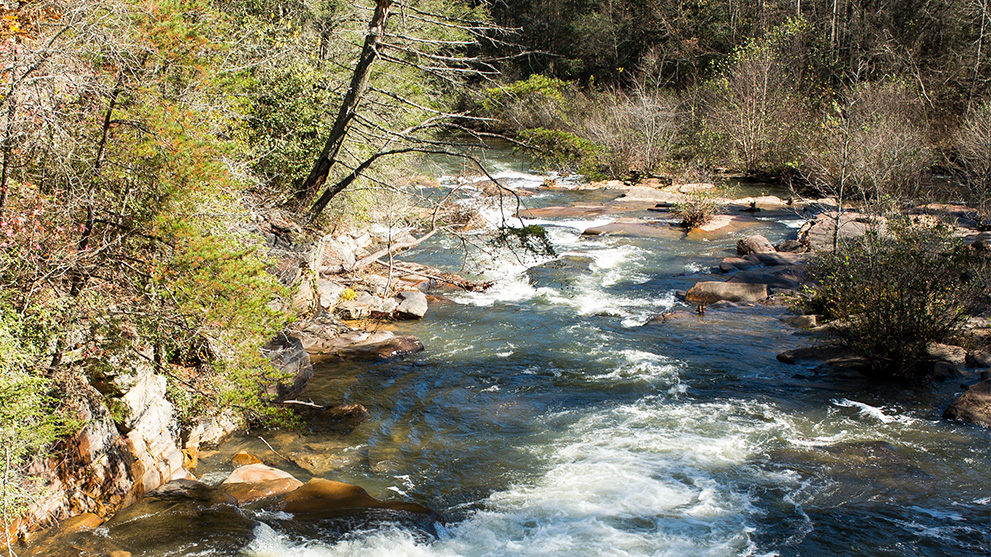
We're committed to protecting and improving the water resources that sustain communities across our state.
Since 2019, the Georgia Power Foundation’s Waters for Georgia grant program has partnered with qualified nonprofit organizations and governmental agencies to fund conservation, restoration, and water quality improvement projects across the state. The program is designed to support projects that help improve water quality and contribute measurable benefits for environments and communities across the state of Georgia.
The program is administered on behalf of the Georgia Power Foundation by the Bonneville Environmental Foundation (BEF) and operates through multi-year grant cycles. Over its funding history, the program has awarded substantial financial support to numerous water grants across the state, prioritizing projects that deliver long-term ecological health and supporting initiatives that impact underserved communities.
How it Works
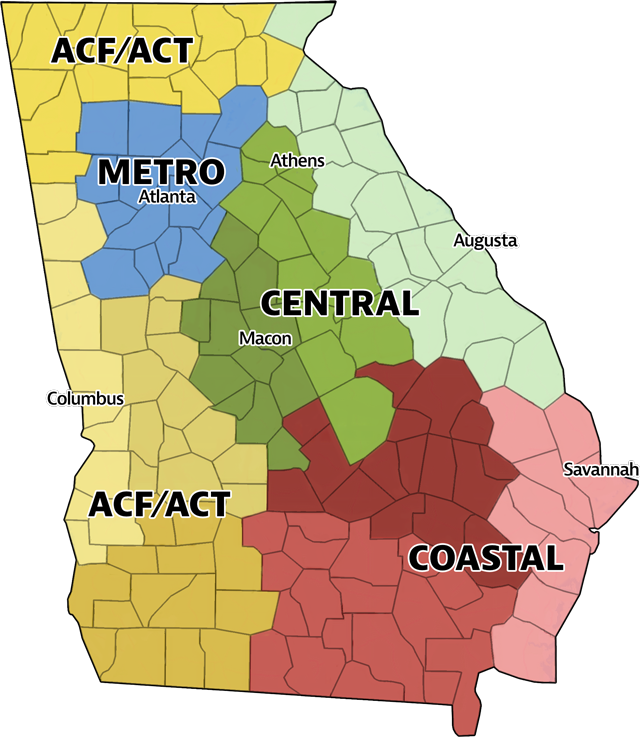
Grant cycles occur every other year (odd years), and focuses on two-three regions within the state.
For the current (2027-2028) grant cycle, projects must be within the following regions:
- Coastal
- Central
- ACF (Apalachicola-Chattahoochee-Flint) / ACT (Alabama-Coosa-Tallapoosa)
Total funding for this cycle is expected to be $1,500,000. Grant funds are intended to be split between the selected regions. A total of 1-3 projects will be funded in each region.
How to Apply
The application process consists of two steps:
- Submittal of a project concept
- Based on the results of the project concept review, selected project proponents will be invited to submit a full proposal.
To submit a project concept please download the project concept template below to get started.
Have Questions?
Project Questions / Considerations
Robert Warren — Bonneville Environmental Foundation
rwarren@b-e-f.org
360-391-8491
Waters for Georgia Program Questions
Joshua Brown — Georgia Power Foundation, Inc.
JOBROW@southernco.com
404-275-6240
Applicant Eligibility
The Georgia Power Foundation considers proposals from:
- Governmental agencies
- Organizations with active 501(c)(3) tax status under Section 509 of the Internal Revenue Code (excluding organizations under Code Section 509(a)(3)(B)(iii) that are not “functionally integrated” with their supported organization)
The Foundation does not fund:
- Individuals, private elementary or secondary schools, religious organizations, or political campaigns or causes
- Organizations whose policies or actions discriminate on the basis of race, color, national origin, sex, religion, gender identity, sexual orientation, age, or disability
- Projects designed to mitigate legal or regulatory compliance obligations, or tied to ongoing legal or regulatory action
Project Types Eligibility
All projects must have a clear link to watershed and aquatic ecosystem health. Projects that also address community well-being, water supply sustainability, or resilience are strongly encouraged.
Examples include (not exhaustive):
- Agricultural Best Management Practices linked to improved water quality (stream fencing, off-channel livestock watering, sediment control, etc.)
- Physical enhancement of aquatic or riparian habitat (buffer revegetation/restoration, stream channel reconstruction, instream habitat structures, fish/aquatic passage improvements, barrier removal)
- Water conservation (irrigation efficiency, groundwater recharge, floodplain reconnection)
- Green infrastructure for stormwater runoff management, to the extent it affects water quality impairment
- Other project types that directly address and enhance water quality and aquatic habitats and meet program criteria
Grant Cycle Timeline (2027 - 2028)
| Step | Approximate Timing |
| 1. Prospective applicants will submit a project concept | August - October, 2026 |
| 2. Selected project concepts will be invited to submit a full proposal | October 2026 |
| 3. BEF will support proposal development | November 2026 - January 2027 |
| 4. Proposal will be reviewed by Georgia Power Foundation and may include follow-up questions | February - March, 2027 |
| 5. Funding recommendations will be presented to the board for approval | May 2027 |
| 6. BEF will work with successful applicants to onboard into financial management system | May 2027 |
| 7. Grant agreements are prepared and executed | May - June, 2027 |
| 8. Grant agreements will be executed | July 2027 |
| 9. Funds are disbursed | July 2027 |
| 10. Project implementation and reporting | July 2027 - December 2028 |
How Projects are Evaluated
Final project selection is made based on the recommendation of the review committee.
Priority is given to projects that:
- Have the potential to positively impact the long-term ecological health of the water body and larger watershed
- Contribute to species conservation in biologically impaired streams, particularly involving rare, threatened, and endangered (RTE) species
- Can be monitored by an existing or proposed monitoring plan
- Provide clear social co-benefit(s)
- Leverage cost-sharing and/or matching funds through private donors, corporate partners, and/or government funding (e.g., state 319(h) grants) to maximize overall project value
- To ensure funding is directed where it's most needed, proposed projects should contribute to existing regional or watershed-scale conservation, restoration, or improvement plans or initiatives.
- Will be implemented and begin delivering benefits by December 31, 2028
Past Grant Recipients
2025 Recipients
- The Nature Conservancy — Prater’s Mill Dam Removal
- American Rivers — Flint Headwaters Restoration and Nature Preserve
- Southeastern Association of Fish & Wildlife Agencies — Streambank and Riparian Enhancement for Native Black Bass Protections
2023 Recipients
- Georgia Conservancy — Living Shorelines: shoreline stabilization preventing coastal erosion and flooding in Howard Coffin Park.
- Seabrook Village Foundation — Martha Randolph Stevens Park: implement a living shoreline approach, leveraging bioengineered materials and native vegetation to combat erosion along the tidal stream's banks.
- Trust for Public Land — Chattahoochee Riverlands Gateway Park: restoring hydrological infrastructure, introducing green infrastructure, and vegetating riparian buffers.
2021 Recipients
- Flint River Soil and Water Conservation District — Restoration of Spring Creek through Agriculture.
- Flint Riverkeeper, Inc. — Development of a De-Listing Plan for Pigeon Creek, Flint River, GA.
- Phinizy Center for Water Sciences, Inc. — Fecal Pollution Monitoring and Microbial Source Tracking of Brushy Creek.
- The Conservation Fund — Building a Park with Purpose: restoring Proctor Creek, reducing urban flooding, and uplifting equitable community-driven outcomes in the Hunter Hills neighborhood of NW Atlanta.
- The South Fork Conservancy — Rain Gardens at South and North Forks of Peachtree Creek.
- The South Fork Conservancy — Runoff Mitigation at Nickel Bottom Community Garden.
- Trees Atlanta, Inc. — Green Streets and Clean Streams Phase II: building a citywide green infrastructure program for Atlanta communities.
2019 Recipients
- Chattooga Conservancy, Inc. — Rabun County Agricultural Best Management Practice Project, Green Infrastructure Project, and Warwoman Creek Pollution Mitigation Project.
- City of Hinesville — Peacock Creek Restoration: a green infrastructure demonstration in historic downtown Hinesville's Bradwell Park.
- Environmental Community Action, Inc. — Stormwater Capture and Reuse for Proctor Creek water quality improvements and potable water conservation at Spelman College.
- Golden Triangle Resource Conservation and Development Council — Spring Creek Stream Bank Stabilization Project.
- Nature Conservancy, Inc. — Removing Barriers to Aquatic Connectivity in the Holly Creek Subwatershed of the Conasauga River.
- Southeastern Association of Fish & Wildlife Agencies — Hillabahatchee Creek Restoration (addressing fecal coliform impairment through livestock exclusion BMPs) and Soque River Watershed riparian restoration (addressing nonpoint source pollutants through agricultural BMPs).
- South River Watershed Alliance — Panola Shoals Riverbank Stabilization and Restoration Project.
- Trees Atlanta, Inc. — Green Streets and Clean Streams: building StreetSide green infrastructure for Atlanta communities.


